

It's 10:45 AM. Three rooms finish within 15 minutes of each other. The PACU has two open bays and one available nurse. So a patient who is ready to leave the OR stays on the table, the room sits occupied, the next case starts late, and somebody says what everybody's thinking: "The PACU is holding us up again!"
PACU holds are one of the most frustrating delays in perioperative services because they feel so random. One day everything flows. The next day the OR is stacking up patients by mid-morning. But PACU holds are rarely random, and they're rarely the PACU's fault. In most cases, the backup was built into the schedule before the first patient was wheeled in at 7 AM.
What is a PACU hold?
A PACU hold happens when a patient who is ready to leave the operating room can't be transferred to the post-anesthesia care unit (PACU) because no bay or recovery nurse is available. The patient stays in the OR with the anesthesia team, the room can't be turned over, and every case scheduled after it in that room is pushed back.
It has a close cousin on the other side of recovery: PACU boarding, where a patient who has finished recovering can't leave the PACU because there's no inpatient bed or transport available. Boarding takes up the bays that the next wave of OR patients needs, which is how a bed problem upstairs becomes an OR hold downstairs.
Either way, the cost lands in the OR: idle rooms, late starts, overtime, and frustrated surgeons.
Why do PACU holds happen?
You'd think a delay that idles a multimillion-dollar operating room would be tracked down to its root cause every time. Yet most organizations treat PACU holds as a capacity problem. The fix is always the same: more bays, more nurses, or more pressure on the PACU team to move patients faster.
Sometimes that's the right answer, but often it isn't. A 2026 simulation study from Duke, published in the Journal of Surgical Research, found that changing only the order of cases, with no added beds or nurses, cut the number of patients held in the OR waiting for recovery by 54%. Same PACU. Same staff. Different timing.
The real problem is rarely the size of the PACU. It's the timing of when patients arrive. A PACU can comfortably handle 40 patients spread across a day and still stumble when six patients arrive in the same half hour.
And what decides when patients arrive? The OR schedule.
What causes PACU delays? The upstream factors
Think about everything that determines when a patient shows up at the PACU door:
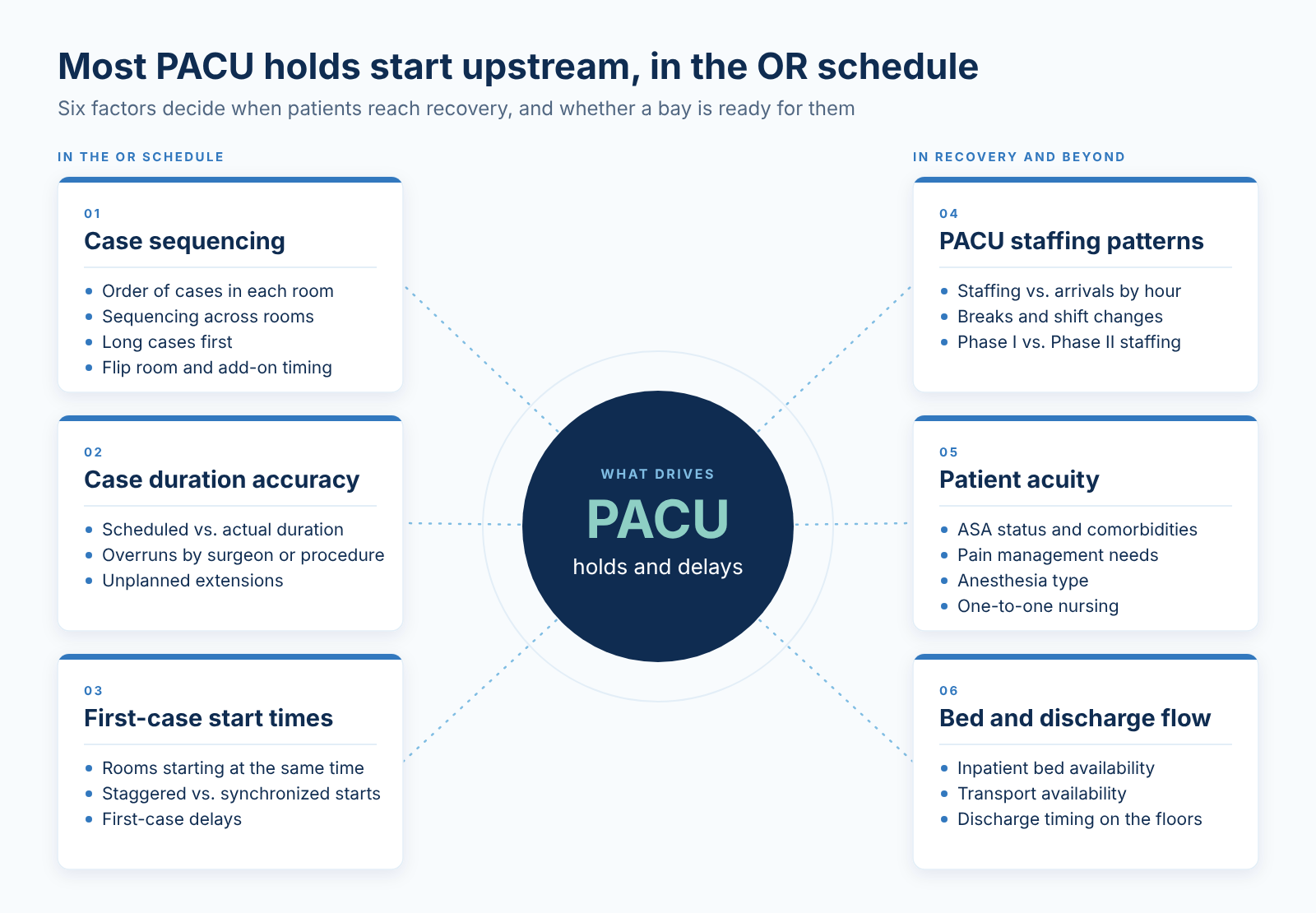
Case sequencing
- The order of cases in each room
- How sequencing lines up across rooms
- Long cases vs. short cases at the start of the day
- Flip room and add-on case timing
Case duration accuracy
- Scheduled duration vs. actual duration
- Consistent overruns or underruns by surgeon or procedure
- Unplanned extensions in complex cases
First-case start times
- How many rooms start at the same time
- Staggered vs. synchronized starts
- First-case delays that compress the rest of the day
PACU staffing patterns
- Nurse staffing by hour vs. patient arrivals by hour
- Breaks and shift changes during peak arrival windows
- Phase I vs. Phase II recovery staffing
Patient acuity and recovery needs
- ASA status and comorbidities
- Pain management needs
- Anesthesia type
- Patients requiring one-to-one nursing
Downstream bed and discharge flow
- Inpatient bed availability
- Transport availability
- Discharge timing on the floors
Most of this list is decided by the OR schedule, before a single patient arrives at the PACU.
Now think about how the typical OR schedule gets built. Most rooms start at the same time. Case order is set by habit or surgeon preference. Durations come from a simple average of the last handful of cases. Nobody looks at what the combined schedule means for the PACU at 10:45 AM. Is it any wonder the PACU gets slammed at the same time almost every day?
Research backs this up. In the 2026 Duke simulation, the order of cases made a big difference in how many patients got stuck waiting for recovery. Scheduling outpatient cases first reduced OR holds by 54% and PACU holds by 15%. Scheduling the longest cases first increased OR holds by 37%. Even better, the gains didn't require every surgeon to change. Much of the improvement came from a small group of specifically identified surgeons.
There's a catch. No single sequencing rule works everywhere. A 2026 review of 26 studies on case sequencing and PACU availability found that popular rules of thumb, like scheduling the shortest cases first, consistently performed poorly. Sequencing changes pay off when they're based on real analysis of your own data. In other words, the fix isn't a new rule. It's knowing your schedule well enough to change the right cases.
Is your OR schedule creating your PACU holds? Let the Leap Rail team do an assessment of your organization and find out where your delays really start.
The highway on-ramp problem
Picture a busy highway on-ramp. Some on-ramps have a meter, a little traffic light that lets cars onto the highway one at a time, every few seconds. It can feel annoying when you're sitting at the light, but the meter is the reason the merge keeps moving. Now take the meter away during rush hour. Every car hits the merge at once, nobody can get in, and the backup stretches all the way down the ramp, even though the highway itself has plenty of room!
Your PACU is the highway. Your OR schedule is the on-ramp meter. When the schedule releases patients in waves (synchronized starts, longest cases first, durations that are off by 30 or 40 minutes), every room finishes at once and the merge jams. You can't fix that by widening the highway. You fix it by metering the on-ramp: building a schedule that predicts when patients will actually arrive and spreads those arrivals out.
How do you measure PACU holds?
You can't fix what you can't see, and many organizations only hear about PACU holds when a frustrated surgeon brings them up. Here's how to put real numbers behind them:
- OR hold minutes. Track the time between when a patient is ready to leave the OR and when they actually leave. Total it by day, by room, and by time of day.
- Days with at least one PACU admission delay. Researchers often use this measure because it's more telling than the average. A PACU that's fine on average but backs up three days a week has a real problem.
- PACU arrivals by hour vs. nurse staffing by hour. Put these two curves on the same chart. The gaps are where your holds come from.
- PACU length of stay by cause. Separate clinical delays (pain control, hemodynamics) from operational delays (waiting on a bed, transport, or discharge orders). In one study of 2,387 PACU patients, unavailable ward beds were the leading cause of prolonged PACU stays, ahead of pain management.
- Case duration accuracy. Compare scheduled vs. actual case durations by surgeon and procedure. If your durations are off, your PACU arrival predictions are too. (More on that in our post on surgical case duration accuracy.)
When you line these numbers up, a pattern usually jumps out: the same few hours, the same few rooms, the same few sequencing habits.
How to prevent PACU holds
The good news is that you don't have to keep fighting PACU holds one morning at a time! Most of the fixes start upstream:
- Predict case durations accurately. Every downstream plan depends on knowing when cases will actually end. Simple historical averages can't do that. At Leap Rail, we use more than 1,500 data dimensions from your existing EMR data to predict surgical case duration. A study by Harvard Medical School, published in the Journal of Medical Systems, showed the Leap Rail method resulted in a 70% reduction in overall scheduling inaccuracy.
- Sequence with data, not rules of thumb. Look at how cases across all rooms will feed the PACU. Targeted changes, like scheduling outpatient cases earlier for a small group of surgeons, can cut holds significantly. Blanket rules, like shortest cases first, can make things worse.
- Stagger first-case starts where it makes sense. Even a 15–30 minute stagger across a few rooms can break up the first wave of PACU arrivals.
- Staff the PACU to the arrival curve. Match nurse staffing, breaks, and shift changes to when patients actually arrive, not to a flat daily average.
- Fast-track the patients who qualify. Not every patient needs a Phase I bay. One academic hospital that opened a Phase II PACU and adopted a fast-track scoring tool reached a 30% PACU bypass rate and shortened PACU stays for its ambulatory surgery patients.
- Fix the exit, not just the entrance. Work with bed management and transport so recovered patients aren't boarding in bays the OR needs.
- Give everyone the same real-time picture. When the OR, PACU, and inpatient units can all see where each patient is, teams can spot a coming wave before it hits. Leap Rail's communication and collaboration tools are built to give every team that shared view.
With accurate durations and a clear view of the whole day, surgical scheduling can account for PACU capacity instead of colliding with it. And OR analytics can show you exactly which days, rooms, and sequencing patterns are creating your holds.
Is your organization ready?
Are you curious how much of your PACU backup is really an OR scheduling problem? Let the Leap Rail team do an assessment of your organization.