

If you're building an OR technology request for 2027, expect a tougher budget committee than the one you faced a year ago. In Sage Growth Partners' Health IT Purchasing Forecast 2026–2027, four in 10 hospital and health system executives said they expect capital budgets to shrink. In the same survey, 77% said anticipated return on investment is the single most important factor in technology purchasing decisions.
The pressure isn't easing in the new budget year. Fitch Ratings expects Medicaid changes under the One Big Beautiful Bill Act to begin materially affecting providers in 2027.
That's the room your OR technology proposal walks into. It isn't hostile to perioperative investment, but it is crowded with competing requests. It also has less patience than ever for proposals that describe what a tool does instead of what it returns.
Most OR technology proposals don't lose on merit. They lose on framing. A request built around better visibility, smoother workflows, and happier staff will lose to a request built around recovered revenue, protected margin, and a credible payback period, even if the first one solves a bigger problem. This guide walks through how to structure an OR technology capital budget proposal section by section, how to handle the objections you'll hear, and how to answer the "why now" question.
Why do OR technology proposals get denied?
OR technology proposals usually get denied for one of three reasons, and none of them is that the technology doesn't work.
They speak the wrong language. Perioperative leaders think in turnover minutes, first-case starts, and block utilization. Finance committees think in net revenue, contribution margin, payback, and risk. A proposal that never translates the first set into the second asks the committee to do the math themselves.
They have no baseline. "We'll improve block utilization" is a hope. "Our orthopedic block utilization averaged 68% over the last 12 months, and every point is worth roughly $X in recoverable OR time" is a business case. Without current-state numbers, the committee has no way to judge whether the projected gains are credible.
They don't address risk. Every committee member has watched a technology investment fail to deliver. Name the risks, timelines, and blockers and explain how you'll manage them.
The fix for all three is structure. The rest of this guide lays it out.
The three questions every proposal must answer, in order
Before you build slides, make sure your proposal answers these three questions, in this order:
- What is the status quo costing us? Establish the problem in dollars before you introduce any solution. If the committee doesn't agree that the current state is expensive, nothing else matters.
- What do we get back, and when? Quantify the return with conservative, base, and upside scenarios, and state the payback period plainly.
- What happens if it doesn't work? Explain how the investment is phased, what you'll measure, and what the pivot looks like if the early results don't show up.
The order matters. Leading with the solution invites the committee to evaluate features. Leading with the cost of inaction invites them to evaluate a decision.
Structuring your OR technology capital budget proposal
1. Executive summary
State the problem, the ask, the expected return, and the payback period in four or five sentences. Many committee members will read nothing else before the meeting. Write this section last, and write it so that it could stand on its own.
2. The cost of the status quo
This is where most proposals are thinnest, and where yours should be strongest. OR time is getting more expensive fast. Recent studies found that the average cost of an OR minute can reach $100, with costs growing each year. Wages and benefits make up roughly two-thirds of direct costs.
Meanwhile, hospital expenses are outrunning revenue. The American Hospital Association's most recent Cost of Caring report found that total hospital expenses rose 7.5% in 2025, while hospital prices rose only 3.3%. Supply expenses alone rose 9.9%.
Translate that context into your own numbers. Pull 12 months of data on unused or late-released block time, same-day cancellations, first-case delays, and overtime. Then price it.
3. The financial return
Separate your return into two buckets, because committees weigh them differently:
- Revenue recovery: additional cases performed in recovered OR time, reduced leakage from cancellations, growth in high-margin service lines.
- Cost avoidance: reduced overtime and agency labor, fewer staff hours spent on manual coordination, lower supply waste.
Build your base case on assumptions your finance team will recognize, and make the conservative case genuinely conservative. If the investment pays back even under the conservative case, say so in bold.
State the payback period in months, not years. Shorter time-to-value is now a competitive advantage inside the capital process.
4. Implementation plan and risk management
Show the committee that you've thought about what could go wrong. Cover:
- Phasing: Will you start with one module, one service line, or one campus? A phased rollout reduces exposure and produces early proof points.
- Dependencies: What does IT need to do? What EHR integration is required? (In the same survey, 68% of executives named EHR integration as a key purchasing factor.)
- Measurement: Which two or three metrics will you report, how often, and against which baseline?
- Exit criteria: What results at 90 and 180 days would justify continuing, and what would trigger a pause?
5. Governance and accountability
Name the executive sponsor, the operational owner, and the clinical champion. Committees fund people as much as they fund plans.
6. The ask
Restate the dollar amount, the contract structure, the timeline, and the decision you need. Make it easy to say yes.
Capital expense or operating expense? Know before you present
Many modern OR technology platforms are sold as subscriptions rather than one-time purchases, which may mean they're funded from the operating budget rather than the capital budget. That changes the conversation. Operating expenses don't compete in the same queue as imaging equipment and facility projects, but they do show up immediately in the department's cost line.
Before you present, ask finance how a subscription of this size would be classified, who approves it, and whether a committee review is still required. Knowing that answer in advance prevents a proposal from being routed to the wrong forum, or approved in principle and then stalled in procurement.
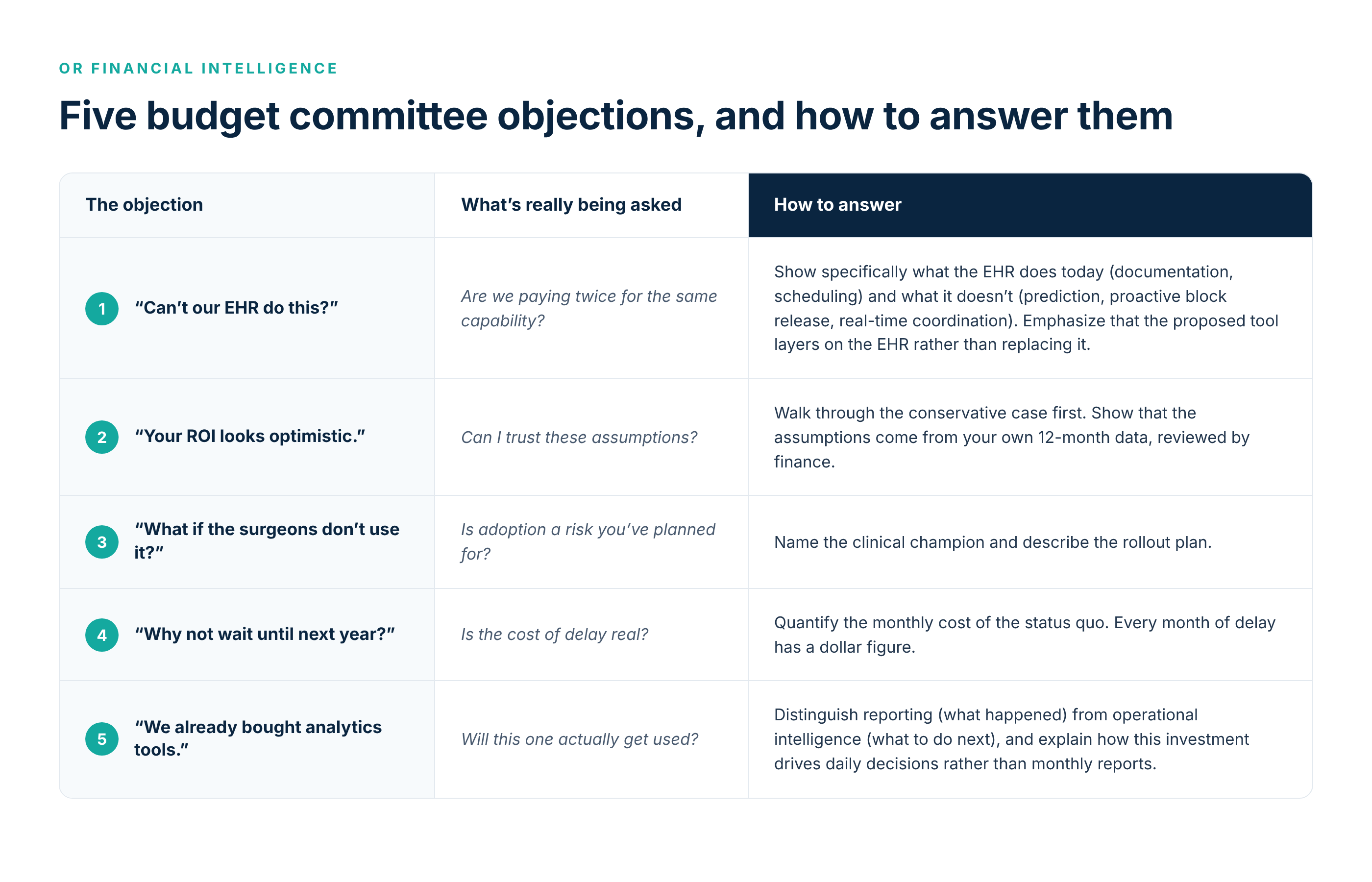
Common budget committee objections and how to answer them
How to answer the "why now" question
"Why now" is the question that decides most borderline proposals. The strongest answers combine three things:
- The cost of waiting, per month. If idle OR time, cancellations, and overtime cost your department a quantifiable amount every month, delay has a price.
- The external pressure. OR costs per minute have grown faster than general inflation, and hospital expenses rose more than twice as fast as prices in 2025, per the AHA. Fitch expects federal Medicaid changes to start weighing on providers in 2027. Margins don't recover on their own, and a request deferred to the 2028 cycle means another year of absorbing those costs.
- The internal trigger. A surgeon recruitment, a new service line, a robotic program expansion, a staffing shortage, or a budget-season reset. Tie the request to something already on leadership's radar.
What approval-winning OR technology proposals have in common
Approved proposals tend to share a few traits. They lead with the cost of the status quo, using the hospital's own data. They show the conservative case first and still pencil out. They're phased, with timelines and expectations. They name accountable people. And they're short: a one-page summary and a handful of supporting slides, with detailed financial models in the appendix.
Above all, they're built with finance, not presented to finance. If your finance partner has reviewed your assumptions before the meeting, the committee is evaluating a joint recommendation rather than a departmental wish list.
Build the financial case with your own data
Leap Rail works with perioperative leaders to quantify the cost of idle block time, cancellations, and delays using their own historical OR data, so the numbers in your proposal are yours, not a vendor's estimate. Because Leap Rail layers on top of your existing EHR and deploys one module at a time, it's built for the phased, measurable rollout budget committees want to see.
Preparing an OR technology proposal for your 2027 budget cycle? Let's discuss your business case and OR goals.